Managing Director, MahaRail
An Indian Railway Service of Engineers (IRSE) officer leading strategic infrastructure projects across Maharashtra — from rail corridor development to statewide road-over-bridge programmes — as Managing Director of MahaRail.
IRSE · Government of Maharashtra & Ministry of Railways
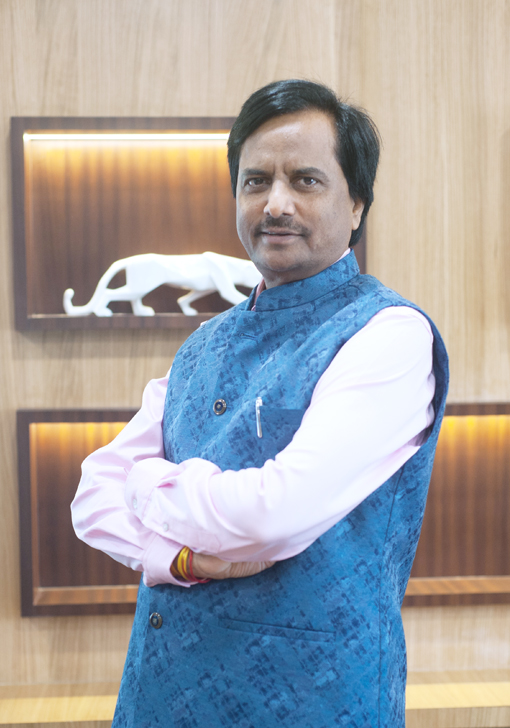
Leading Strategic Infrastructure at MahaRail
Under his leadership, MahaRail has delivered 56 key construction projects across Maharashtra, with hundreds more in active development.
Systematically eliminating dangerous level crossings across Maharashtra's rail network through Road Over Bridges (ROBs) and Road Under Bridges (RUBs).
Closing urban connectivity bottlenecks with flyovers and cable-stayed bridges across Maharashtra's key industrial corridors.
Rajesh Kumar Jaiswal's portfolio includes major infrastructure projects, 15 ROB designs developed in-house by MRIDC and included in the RDSO compendium, and a patent received by MahaRail under his leadership for its invention, “A Concrete Crash Barrier with Integrated Utility Duct”, an important distinction.
Career & Education
B.E. in Civil Engineering (1986); secured AIR 1 with a 99.97 percentile in GATE 1986.
Joined via UPSC in 1986 as an Indian Railway Service of Engineers (IRSE) officer.
M.Tech. in Soil Mechanics and Foundation Engineering (1988).
“Vision of High Speed Rail Corridors in India” (2008), published by Indian Railways.
MBA (Industry Integrated), 2011, strengthening his expertise in infrastructure management and leadership.
Sustainable, Government-Led Development
As a career IRSE officer, his approach to creating infrastructure has consistently prioritized long-term public value over short-term delivery alone, blending engineering precision with durable, cost-effective design suited to Maharashtra's growing urban and rail networks.
MahaRail's infrastructure development mandate extends across various districts of Maharashtra. As a senior IRSE officer with extensive expertise in infrastructure development, his work reflects a statewide approach, rather than a single-city approach, to public infrastructure planning.
Common Questions